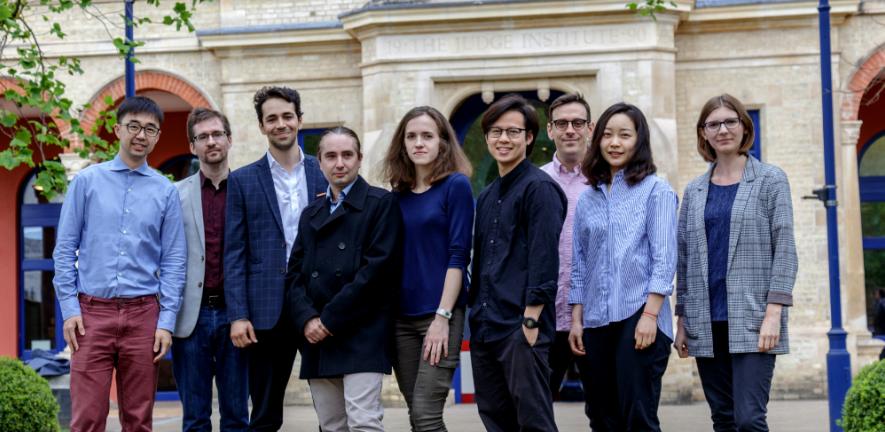
Psychometric Society Meeting in Cambridge: Dissertation Prize
The purpose of this award is to recognize the best Ph.D. thesis that was accepted at a university anywhere in the world during the past year, written in any field covered by the journal Psychometrika. Submitted theses have been evaluated by a panel of three judges comprised of past presidents of the Psychometric Society on the basis of the level of originality in the ideas and techniques, the possible applications and their treatment, and potential impact.
The award consists of a certificate, a monetary prize of $500, and a free one-year membership of the Psychometric Society. The winner is invited to present a summary of their thesis at the 2009 Annual Meeting of the Society A stipend of $1,000 is given to defray expenses to attend the meeting and registration fees are paid.
The 2009 Psychometric Society Dissertation Prize has been awarded to Bonne Zijlstra of the Department of Educational Studies in the University of Amsterdam. Bonne presented a summary of his thesis "A model for multivariate binary social network data" on Thursday afternoon at 16.30 in the Palmeston Lecture Theatre.
Chair: Klaas Sijtsma, Thursday 23rd July, 16.45 - 17.30, Palmeston Lecture Theatre, Fisher Building
Random effects models for directed graphs with covariates
(188B)Bonne J.H. Zijlstra, Department of Educational Sciences, University of Amsterdam, The Netherlands. (Contributors: Marijtje A.J. van Duijn, Tom A.B. Snijders)
A social network consists of a set of actors and the ties between them. The p2 model is a statistical model for the analysis of binary social network data with explanatory variables. It allows, for instance, to test whether a tie between two actors with a common property is more likely. The p2 model places special demands on the estimating algorithm because individual differences in sending ties (activity) and in receiving ties (popularity) are modeled using random effects. Because actors both send and receive ties, a cross-nested pattern of random effects results. For the p2 model newly developed Markov Chain Monte Carlo (MCMC) algorithms appear to provide estimates with small bias and adequate coverage rates. Utilizing the MCMC estimation, a multilevel p2 model, assuming multiple network observations to be representative of a population of social networks, is proposed. This may for instance be the case when networks in multiple school classes are observed. A multivariate p2 model, for the analysis of multiple networks observed on the same set of actors, is proposed as well. For friendship and advice networks between collegues, for instance.